OUR AIM IS TO SHED LIGHT ON THE MOST PRESSING GLOBAL ECONOMIC CHALLENGES TO IMPROVE INTERNATIONAL ECONOMIC POLICY
Updates
Our paper “Putting Economics Back Into Geoeconomics” by Christopher Clayton, Matteo Maggiori, and Jesse Schreger, has been published in the NBER Macroeconomics Annual 2025, volume 40
More information here: https://www.nber.org/books-and-chapters/nber-macroeconomics-annual-2025-volume-40/putting-economics-back-geoeconomics
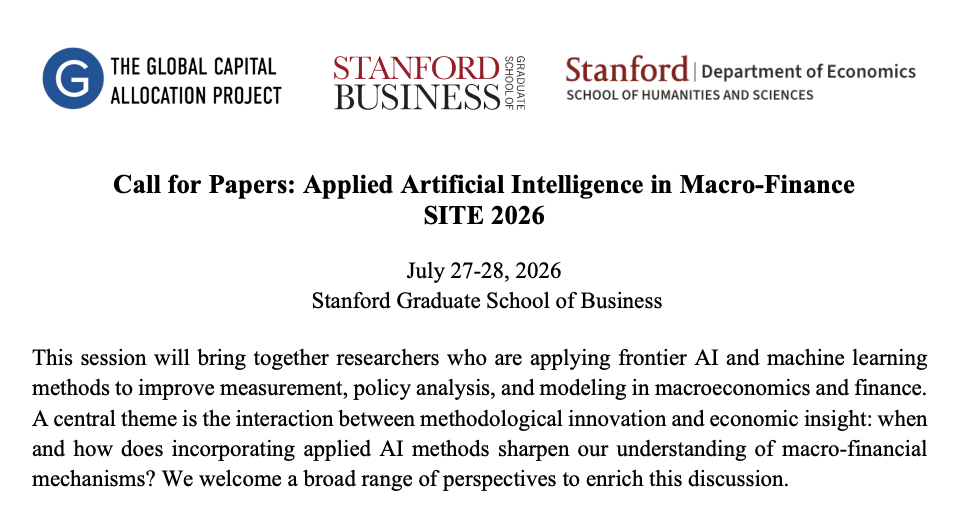
This session will bring together researchers who are applying frontier AI and machine learning methods to improve measurement, policy analysis, and modeling in macroeconomics and finance. A central theme is the interaction between methodological innovation and economic insight: when and how does incorporating applied AI methods sharpen our understanding of macro-financial mechanisms? We welcome a broad range of perspectives to enrich this discussion.
The conference will be organized by Christopher Clayton (Yale University) and Antonio Coppola (Stanford University).
The conference will take place on July 27-28, 2026, at Stanford GSB. The call for papers is available here.
The agenda for the the RFS-GCAP-BGS Conference is now available. It can be viewed here or on the event website.
Our paper “A Framework for Geoeconomics” by Christopher Clayton, Matteo Maggiori, and Jesse Schreger has been published in the Econometrica, Volume 94, 2026.
The agenda for the the JIE-GCAP-BGS Conference is now available. It can be viewed here or on the event website.
We are excited to release a public, research-ready dataset for macroeconomics and finance built from SEC Form N-PORT mutual fund filings. What’s inside: Complete holdings at the security level for U.S. mutual funds and ETFs each quarter.
In the News
“According to a team of academics including Jesse Schreger of Columbia University, by 2025 the share of global companies reporting they were affected by export controls was more than triple the average over the 2010s. The biggest contributors to that were US export restrictions on China.”
”Part of a financial regulator’s role is considering policy interventions to prevent or mitigate financial crises. Rather than predicting crises, [Antonio] Coppola's current work is focused on ‘if this big wave of stress comes along, where are the problems going to be? Who exactly is going to get in trouble?’”
”Jesse Schreger of Columbia University shared findings that after being hit by an export control, Chinese companies were twice as likely as American ones to invest in research and development. In this game, the scores could change.”
“The geoeconomic competition between the United States and China is not a passing phase but a likely defining feature of the years ahead. Korea's success will depend on how skillfully it navigates these treacherous waters.”
“A diferencia de la Guerra Fría, donde los países debían elegir entre Estados Unidos y la Unión Soviética, el actual conflicto comercial entre Washington y Beijing no obligará a Chile a escoger un bando. Esa es la visión de Matteo Maggiori, profesor de Finanzas en la Stanford Graduate School of Business, quien descarta la idea de una división del mundo en bloques comerciales antagónicos.”
“Geoeconomics, the strategic use of economic leverage for geopolitical goals, is a long-standing practice now resurging. Yale's Christopher Clayton explains how nations like the US and China leverage specialized goods and financial systems. He notes that while great powers dominate, smaller nations like Taiwan can also wield influence through critical industries.”